Products / EVA-X GHOST
Quieter · Smarter · Further

EVA-X GHOST

Stealth carrier for a more secure tomorrow. A low-noise, adaptive-visual six-I1 carrier available in battery-electric (GHOST-E) and hydrogen fuel-cell (GHOST-H2) configurations.
Product family

Two energy configurations. One protected magazine.

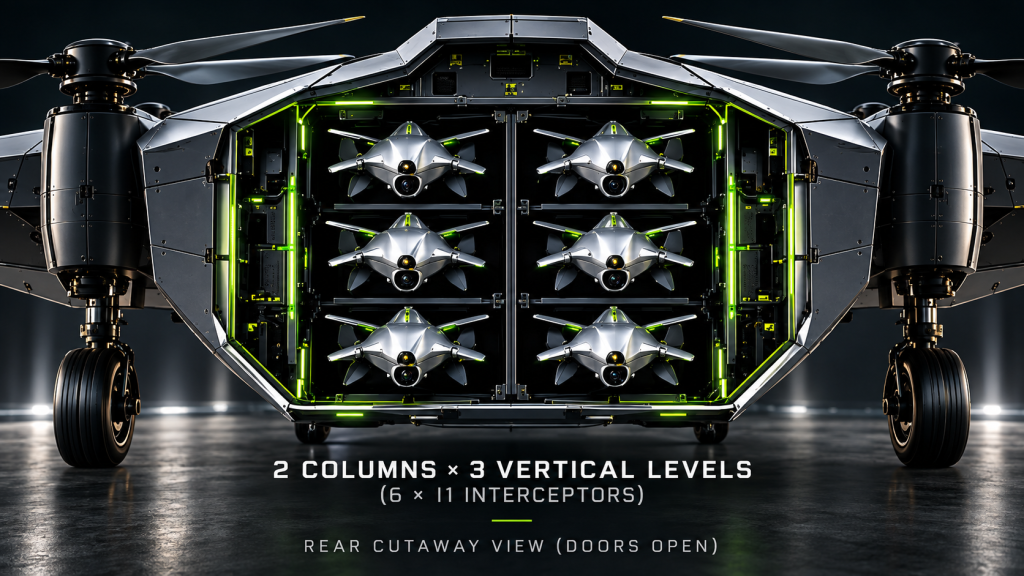
GHOST is maintained in two energy configurations. Both carry six EVA-X I1 ISR/tracking/communications aircraft in a protected 2-column × 3-vertical-level magazine and retain the adaptive visible-light underside. GHOST-E is battery-electric; GHOST-H2 uses compressed hydrogen fuel-cell cruise power with a high-power buffer battery.

6

Six-I1 protected magazine

2 x 3

Column × level arrangement

Adaptive

Visible-light underside
GHOST-specific endurance wing

A larger wing, built to reduce cruise power.

GHOST uses a purpose-built endurance wing rather than the shared 72 in EVA-X MINI airframe wing. The larger wing is a development change intended to reduce wing loading and cruise power — final airfoil, structure, and rotor clearance require validation.
Wingspan (target)
84 in / 2.13 m
Wing area
~7.0 ft² / 0.65 m²
Aspect ratio
~7.0
Cruise band
55–70 mph
Length
44 in / 1.12 m
Height (VTOL)
15 in / 0.38 m
Two energy configurations

Match the powertrain to the mission.

Same magazine, same adaptive underside — endurance, range, and logistics are the trade.
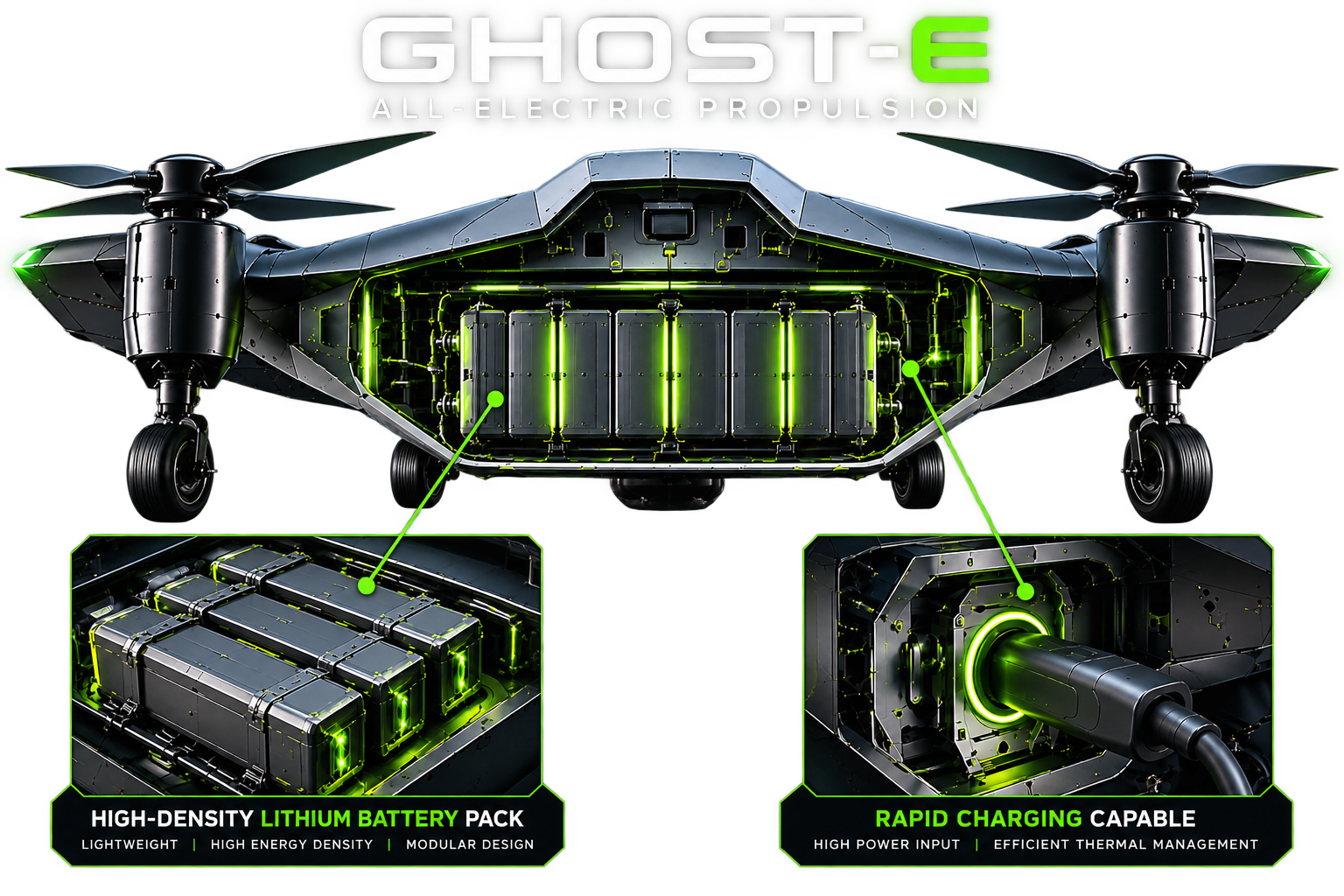
GHOST-E

Battery-electric

The lighter, simpler configuration — all-electric propulsion with no fuel-cell integration to manage.
Run time
~1–2 hr (3+ hr stretch objective)
Range
~60–120 mi
Fuel storage
HV battery, ~14 lb class
Power unit
Battery-electric (no fuel cell)
Battery
~1.6–2.2 kWh stored, ~80% usable
Cruise speed
55–70 mph
Planning estimates only. GHOST-E remains a development design; endurance and range depend on final battery, mass, and CG closure.
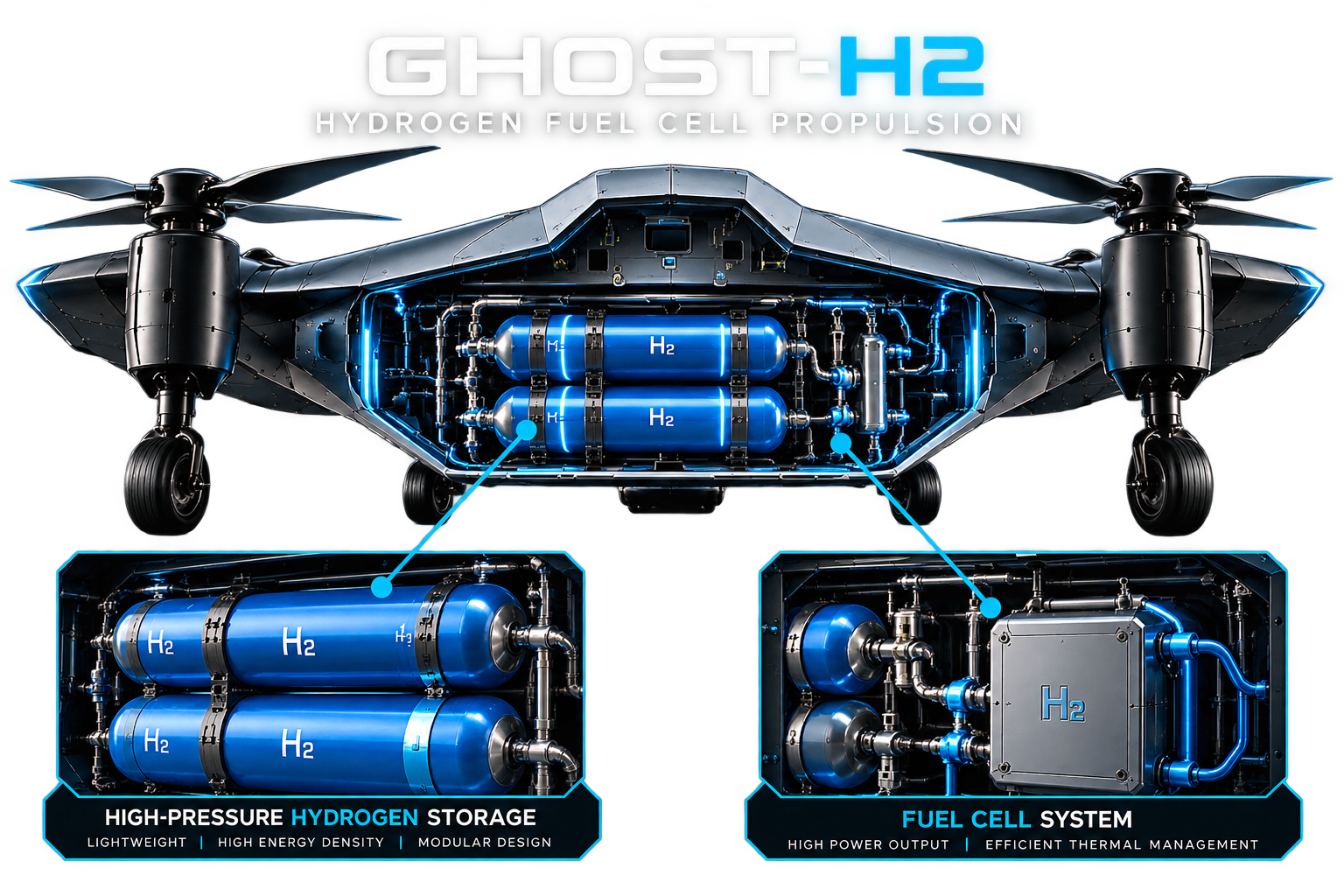
GHOST-H2

Compressed hydrogen fuel-cell

Longer endurance and range, trading simplicity for a PEM fuel cell and compressed-H₂ storage system.
Run time
~3.5–4.5 hr
Range
~200–280 mi
Fuel storage
~0.25–0.35 kg compressed H₂
Fuel cell target
PEM fuel cell, ~2–3 kW continuous target
Battery
~0.5–1.0 kWh buffer
Cruise speed
55–70 mph
Planning estimates only. Final supplier provenance, stack/tank mass, altitude performance, and balance-of-plant loads must be verified.
Side by side

Choose the energy architecture for the mission.

Simpler, lighter

GHOST-E

Battery-electric
~1–2 hr
Run time
~60–120 mi
Range
~66 lb
Fuel type — planning loaded mass
Longer endurance

GHOST-H2

Compressed hydrogen fuel-cell
~3.5–4.5 hr
Run time
~200–280 mi
Range
~72 lb
Fuel type — planning loaded mass
Preliminary cruise power

Modeled power draw across the cruise band.

Variant
55 mph
60 mph
65 mph
70 mph
GHOST-E
1.34 kW
1.42 kW
1.54 kW
1.69 kW
GHOST-H2
1.48 kW
1.55 kW
1.65 kW
1.79 kW
Sizing model: sea-level ISA, CD0 0.055, Oswald efficiency 0.82, 76% propeller efficiency, 92% motor/inverter efficiency, and ~180 W auxiliary load. Not measured performance.
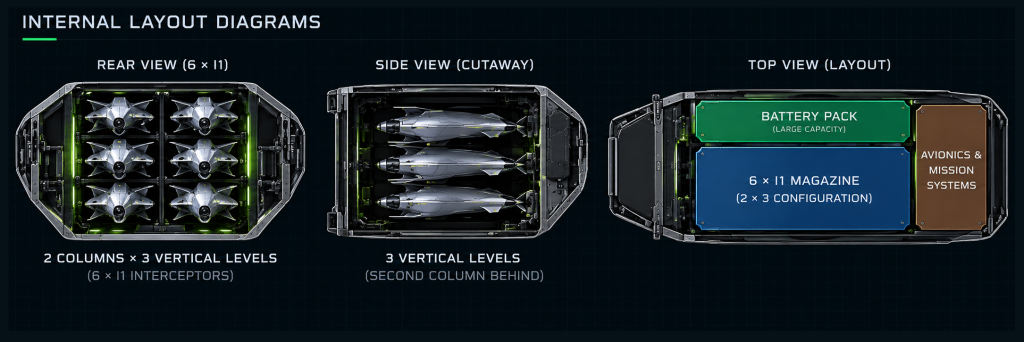
Six-I1 payload magazine

A protected magazine, not an exposed payload rack.

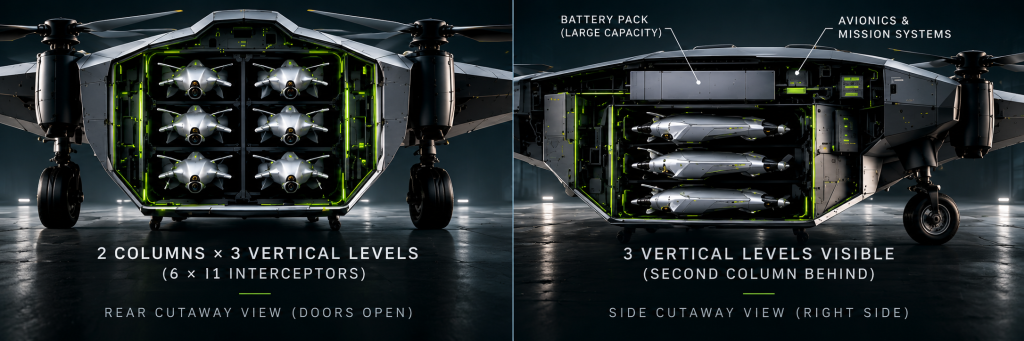
Six I1 aircraft ride in a 2-column × 3-vertical-level magazine (470 × 255 × 380 mm), each ≤1.40 lb for ≤8.4 lb total, plus a ~1.2 lb rack.
REAR CUTAWAY (DOORS OPEN) / SIDE CUTAWAY (BATTERY + AVIONICS)
INTERNAL LAYOUT — REAR / SIDE / TOP VIEW
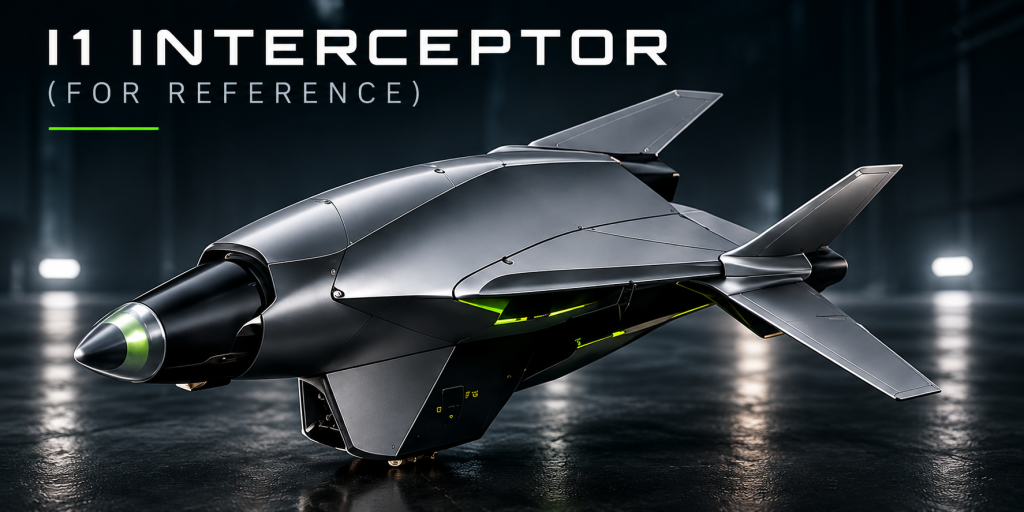
I1 interceptor (for reference)

The aircraft the magazine is built to carry.

Length
10.2 in (260 mm)
Wingspan
7.5 in (190 mm)
Weight (target)
≤ 1.40 lb (635 g)
Variants
I1-EO · I1-LR · I1-R
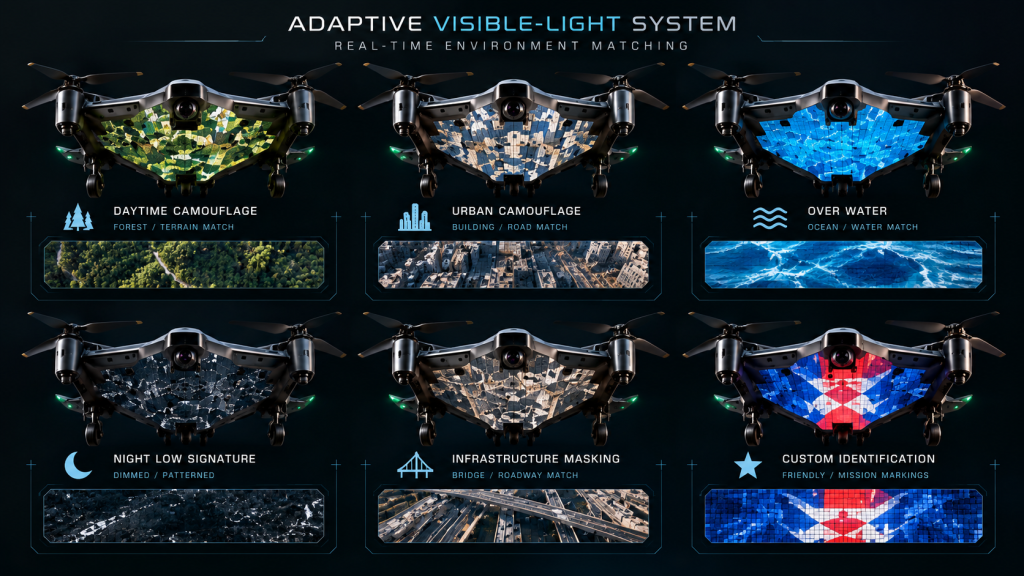
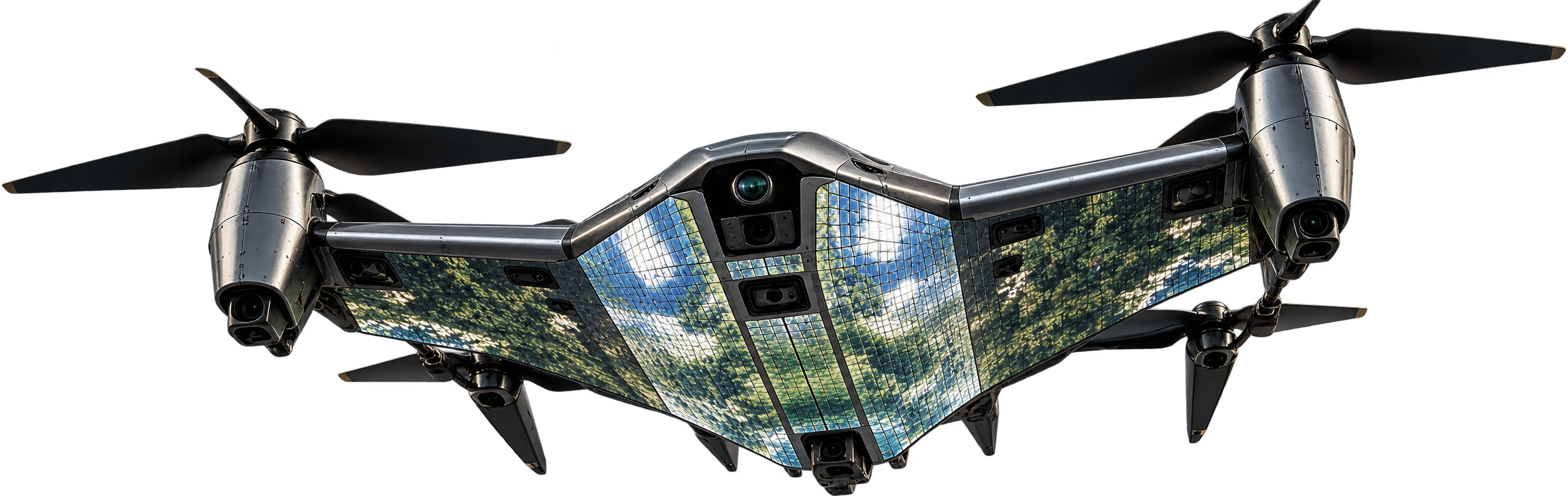
Adaptive visible-light system

Real-time environment matching.

A zoned RGBW display with diffuser, mounted to the underside, is designed to reduce visible contrast against the sky and terrain background — matching in real time rather than relying on a single static paint scheme.

100–150 W

Typical power draw

≤250 W

Peak power

≤3.2 lb

System mass
Fail-safe: passive/off.
Acoustic planning estimates

Modeled sound pressure level by distance.

Distance
Low
Nominal
High
10 m
60 dBA
65 dBA
70 dBA
25 m
52 dBA
57 dBA
62 dBA
50 m
46 dBA
51 dBA
56 dBA
100 m
40 dBA
45 dBA
50 dBA
200 m
34 dBA
39 dBA
44 dBA
500 m
26 dBA
31 dBA
36 dBA
1,000 m
20 dBA
25 dBA
30 dBA
Ideal free-field estimates only — not measured GHOST performance.
GHOST-H2 integration requirements

What the hydrogen system has to solve.

Supply chain & status

Stated plainly, not softened.

Important
No Chinese-manufactured flight-critical or propulsion components are permitted. Both configurations remain development designs; ranges and endurance are planning estimates until supplier data, mass/CG closure, and flight testing are complete.
Mission profiles

Built for presence, not just a single pass.

01
ISR & Reconnaissance
Persistent, low-signature observation of an area or route.
02
Persistent Surveillance
Extended on-station time with a reduced visual and acoustic footprint.
03
Counter-UAS (6×I1)
Deploy the six-I1 magazine for distributed detection and tracking.
04
Border & Maritime Monitoring
Long-range coverage over water and remote border terrain.
05
Urban Operations
Low-noise presence suited to populated or sensitive environments.
06
Tactical Support
Forward ISR and communications relay for supported ground elements.
Quiet capabilities. Real impact.

A smaller footprint. Harder to see.

GHOST-E and GHOST-H2 share one magazine and one adaptive underside — request the full Rev G specification to review planning estimates, open engineering items, and the validation path.