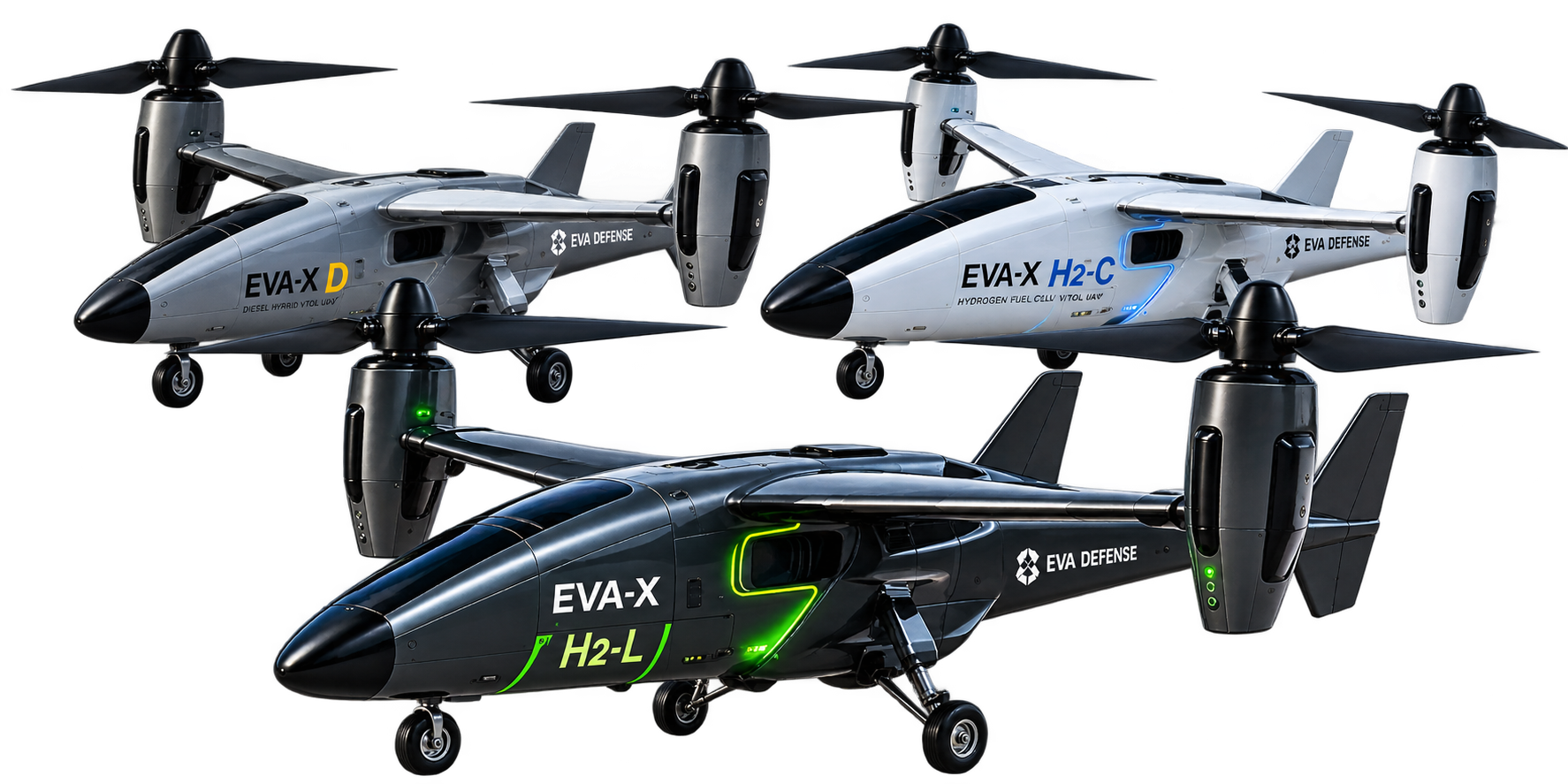
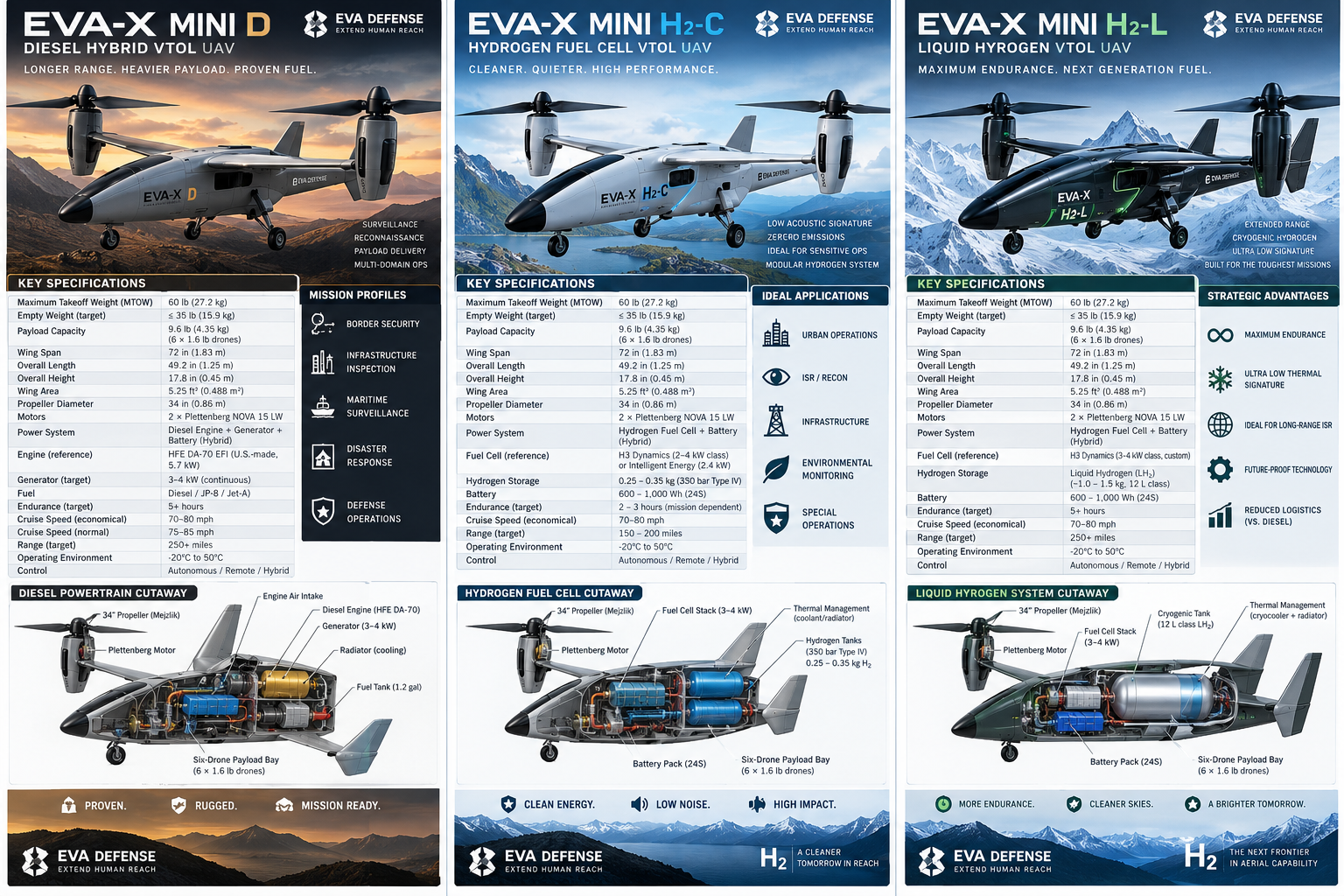
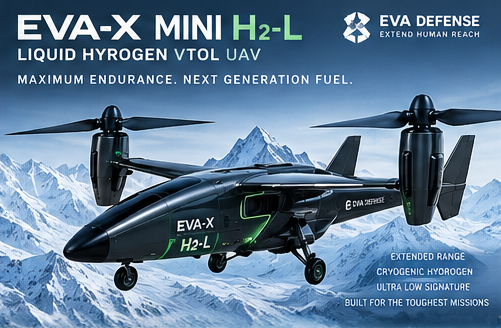
EVA-X MINI shares one airframe, one payload bay, and one flight-control system across three powertrains — diesel-hybrid, compressed-hydrogen, and liquid-hydrogen — so the mission picks the energy source, not the other way around.
A modular VTOL platform built around mission flexibility.
Common airframe and payload architecture; powertrain selected for the operating environment. Every variant shares the same wing, nacelles, landing gear, avionics, flight modes, and payload interfaces — only the energy module changes.
Vertical takeoff and fixed-wing cruise in one compact platform
Six-drone internal payload architecture
Twin electric tiltrotors with common avionics and flight controls
Diesel/heavy-fuel, compressed-H₂, or liquid-H₂ configurations
No Chinese-manufactured flight-critical or propulsion components
The shared air vehicle
Same platform. Same numbers. Across every variant.
60 lb
Structural MTOW
72 in
Wingspan
34 in
Twin rotors
9.6 lb
Six-drone payload
70–80
Econ. cruise (mph)
24S
HV propulsion bus
EVA-X MINI shares one airframe, one payload bay, and one flight-control system across three powertrains — diesel-hybrid, compressed-hydrogen, and liquid-hydrogen — so the mission picks the energy source, not the other way around.
Three energy architectures
Match the powertrain to the mission.
Each configuration carries the same airframe and six-drone payload bay. What changes is endurance, signature, and logistics — pick the trade that fits the operating environment.
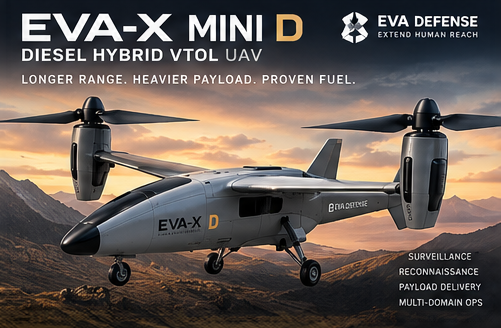
EVA-X MINI D
Diesel / heavy-fuel hybrid-electric
The baseline long-endurance configuration — liquid-fuel logistics, rapid field refueling, and the most mature build path.
Run time
5+ hr
Range
250+ mi
Fuel storage
1.2 gal diesel / JP-8 / Jet-A
Power unit
Generator, 3–4 kW continuous
Battery
400–600 Wh
Cruise speed
75–85 mph
Liquid-fuel logistics and rapid field refueling
Highest energy density of the three variants for long-duration missions
Battery-buffered electric VTOL keeps the rotor architecture common across variants
Performance objectives remain subject to final engine/generator selection, BSFC, drag, and flight-test validation — Rev D engineering baseline, not certified performance.
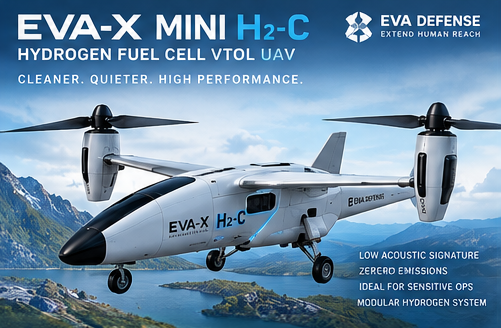
EVA-X MINI H2-C
Compressed-hydrogen fuel cell hybrid
Lower vibration and zero combustion exhaust — a development configuration trading endurance for simpler hydrogen handling.
Run time
~2–3 hr (preliminary)
Range
~150–200 mi (preliminary)
Fuel storage
0.25–0.35 kg H₂, 350 bar Type IV
Power unit
Fuel cell, 3–4 kW class
Battery
600–1,000 Wh
Cruise speed
70–80 mph (economical)
Fuel-cell electric cruise with battery-supported VTOL transients
Reduced vibration and lower-temperature heat rejection
Compressed-H₂ storage trades endurance for simpler handling than cryogenic LH₂
Development configuration; performance is not frozen until a compliant fuel-cell and tank system is selected.
EVA-X MINI H2-L
Liquid-hydrogen fuel cell hybrid
The advanced endurance development configuration — cryogenic storage aimed at diesel-class range with zero combustion exhaust.
Run time
5+ hr (development)
Range
250+ mi (development)
Fuel storage
Liquid H₂, ~1.0–1.5 kg, 12 L class
Fuel cell target
Fuel cell, 3–4 kW class, custom
Battery
600–1,000 Wh
Cruise speed
70–80 mph (economical)
Higher hydrogen volumetric density than compressed gas
Potential path to long-endurance hydrogen operation
Common electric propulsion and payload architecture with H2-C
Advanced development configuration; tank mass, usable LH₂, boil-off, ground handling, and performance require supplier validation.
Side by side
Choose the energy architecture for the mission.
Most mature baseline
D
Diesel / heavy-fuel hybrid
5+ hr
Run time
250+ mi
Range
Liquid diesel
Fuel type — fast field refueling
Preliminary class
H2-C
Compressed hydrogen
~2–3 hr
Run time
~150–200 mi
Range
Compressed H₂
Fuel type — no combustion exhaust, lower vibration
Advanced development
H2-L
Cryogenic hydrogen
5+ hr
Run time
250+ mi
Range
Cryogenic H₂
Fuel type — no combustion exhaust, advanced endurance path
Payload architecture
A six-drone payload architecture multiplies mission reach.
Six internal payload drones at 1.6 lb each, released from a quick-release internal rack with common mission interfaces. The carrier aircraft handles VTOL launch, efficient transit, and deployment — the payload set can be tailored to the approved mission.
6
Payload drones
9.6 lb
Total payload
1.6 lb
Per drone
Drone wingspan
26.0 in / 66 cm
Drone length
16.5 in / 42 cm
Drone height
3.1 in / 8 cm
Drone weight
1.6 lb / 0.73 kg each
Drone battery
LiPo 6S 6000 mAh
Launch method
Internal bay / air drop
Supply chain policy
Designed around a U.S. / allied supply chain.
Country of manufacture and critical-component provenance are controlled procurement requirements — not a marketing claim. A common-platform bill of materials enables supplier qualification across all three variants, and prototype supplier selections remain subject to written provenance and qualification.
No China
No Chinese-manufactured flight-critical or propulsion components
Common BOM
Maximize cross-variant parts to preserve manufacturing leverage
Traceable
Country-of-origin documentation for every flight-critical subsystem
Production economics
Unit cost is designed to improve rapidly with scale.
Current planning estimates for the base aircraft, excluding mission payload sensors, NRE/tooling, ground station, and certification.
$53.2K
10-unit recurring estimate
$31.0K
100-unit recurring estimate
$18.9K
1,000-unit recurring estimate
Largest cost-reduction opportunities: engine/generator, electric propulsion electronics, and composite airframe.
A common airframe across D / H2-C / H2-L is intended to preserve manufacturing leverage.
Hydrogen-variant production cost remains supplier-dependent and is not yet frozen.